Saree fall & edging: the finishing touches your saree actually needs
Nobody compliments the hem at a wedding. But the hem is what makes the whole drape work.
You’ve picked the saree. The blouse is stitched. The jewellery is set out. And then at the event the hem floats, the pleats come undone by hour two, and you spend the evening managing your outfit instead of enjoying it.
The problem isn’t the saree. It’s the finishing.
Saree fall and edging are two small details that most people only notice when they’re missing. Done right, they’re invisible which is exactly how they should be. They simply let your saree do what it’s supposed to do: drape beautifully, stay in place, and last for years.
What is a saree fall and what does it actually do?
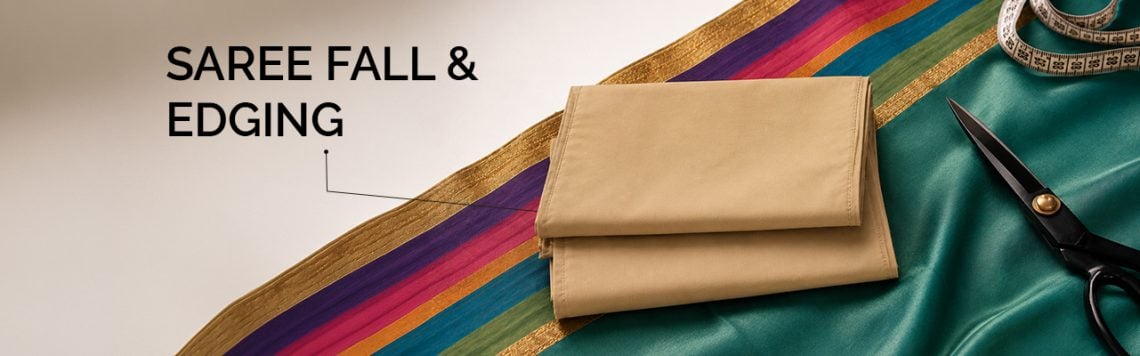
A saree fall is a thin strip of fabric stitched along the inside of the bottom hem. That’s the whole definition. But what it does is considerably more than the description suggests.
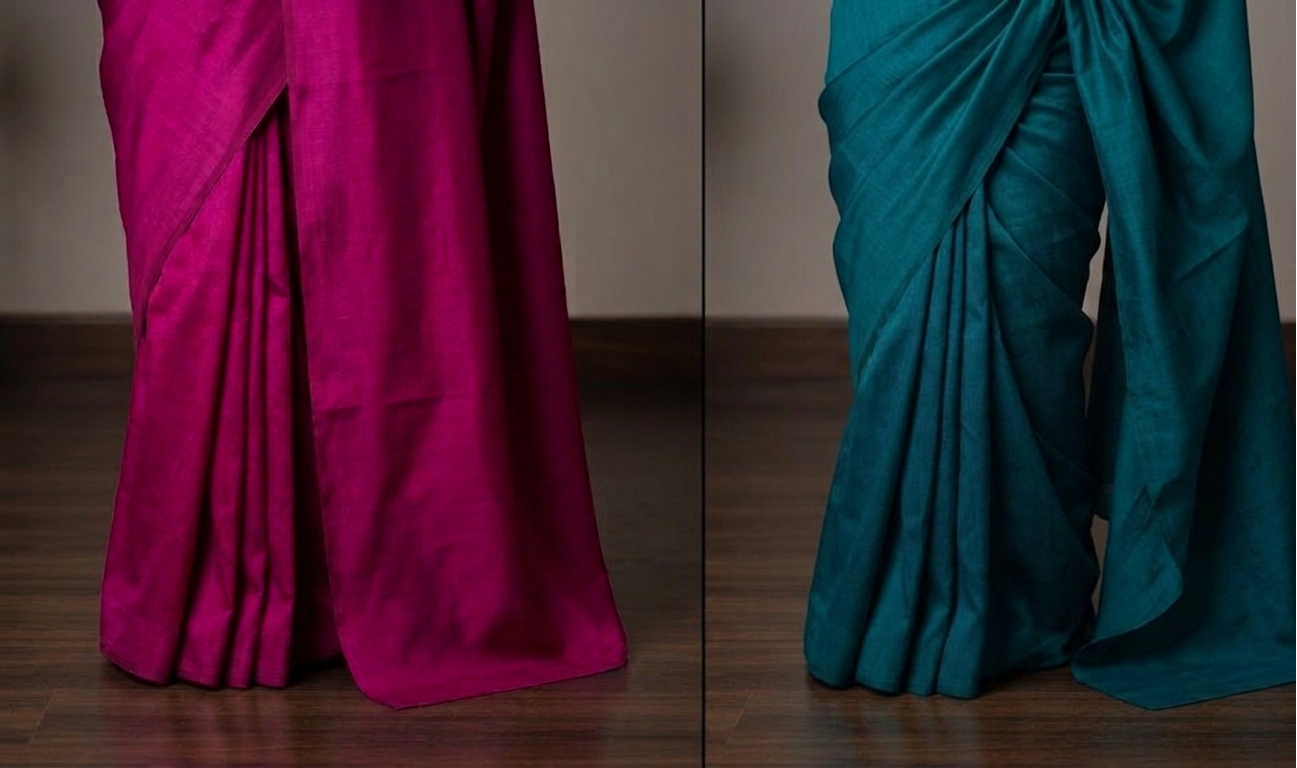
The fall adds just enough weight to the hem to keep it grounded. Without that weight, lightweight fabrics georgette, chiffon, organza don’t have enough mass to drape smoothly. The hem floats, the pleats lose their shape as you move, and the whole silhouette starts to feel like something you’re actively holding together rather than wearing.
With fall stitching, the hem stays where it’s placed. The fabric moves with you instead of away from you. The pleats hold from morning through to the end of the evening. And the saree whatever the fabric, whatever the occasion drapes the way it was always meant to.
“Think of it as the anchor your saree quietly needs. With it, everything just falls into place — naturally, effortlessly.”
What is saree edging and why do borders need protection?
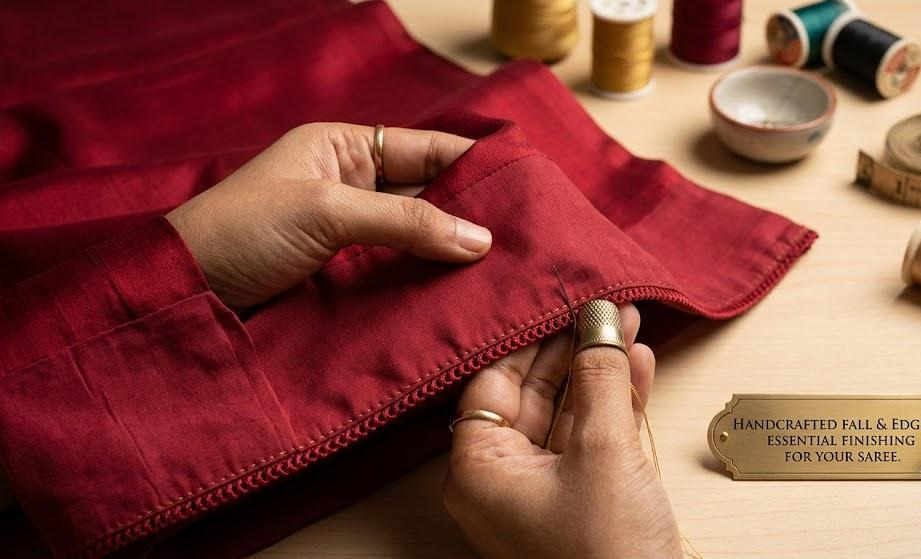
Edging is the finishing applied to the raw border of the saree the strip along the length of the fabric where the weave ends and the loose threads begin.
Left unfinished, those edges fray. Over time and with repeated washing, they pull. The border puckers. The shape that was so precise when you first received the saree gradually loses its line. This happens with even the most expensive fabrics because it’s not about quality, it’s about whether the edge has been properly sealed.
Good edging protects the border from the friction of draping, the stress of repeated folding, and the wear of regular use. It’s what lets a silk saree look as crisp at its tenth wear as it did at its first.
4 common saree problems and how fall & edging solve them
These aren’t rare complaints. They’re what most saree wearers experience at some point and in every case, the fix is simpler than the frustration it causes.
PROBLEM 1:The hem that won’t fall straight Lightweight fabrics lack the mass to drape neatly. Fall stitching adds just enough weight at the base to keep the hem grounded and the fabric flowing in a clean, unbroken line.
PROBLEM 2:Pleats that come undone mid-event Without a weighted hem, pleats loosen every time you take a step. Fall stitching distributes weight evenly across the base so the front pleats stay set from the first drape to the last dance.
PROBLEM 3: Borders that fray after one season Raw edges degrade quickly with washing and wear. Edging seals the border so the saree holds its original finish — through multiple wears, through the dry cleaner, through years of careful use.
PROBLEM 4:The extra tailor visit after delivery Most sarees arrive unworn-ready. Fall and edging have to be arranged separately, adding time and cost before you can even try it on. Cbazaar handles both before it ships so the box you open is a saree you can wear.
Why Cbazaar’s fall & edging service is worth it
Any tailor can stitch a fall. But there’s a difference between stitching done quickly and stitching done well and that difference shows up in the drape.
At Cbazaar, fall and edging work is done by artisans who understand fabric. The technique used for a heavy Kanjivaram is not the same as the one used for a delicate Chiffon. The fall fabric itself is matched to the saree not a generic strip that adds bulk or shows through at the hem.
- Technique matched to fabric weight and weave
- Fall fabric colour-matched to your saree
- Ships ready to drape no tailor visit needed
- Stitching built to last through regular wear
- Edging that holds its finish after washing
- Available at checkout for any saree in the catalogue
The result is a saree that arrives finished not just packaged. Open the box. Drape it. Wear it to the occasion. That’s how it should work.
How fall & edging extend the life of your saree
A saree is rarely a single-use purchase. It’s worn across seasons, stored between celebrations, handed down if it’s precious enough. The finishing it receives determines how it holds up through all of that.
A properly stitched fall protects the hem from the friction of dragging across floors something that happens every time you walk in a full drape. Edging prevents the slow unravelling that begins the moment a raw border meets repeated folding and washing.
Together, they’re what lets a saree look new at its fifth wear. Or its fifteenth. They’re not just about how the saree looks today they’re about how it will look every time after that.


You May Also Like

Black Friday Week Mega Offer: Buy 1 & Get 2 free with free shipping and free stitching
Everything You Need to Know About Shapewear for Ethnic Wear